Dublin


May 13, 2025
We left SFO on a nonstop flight to Dublin, just before 6 pm California time. We would arrive at the Dublin Airport about noon the next day. The travel time was about 10 hours and a distance of 5,098 miles.


Above is a map showing the route of our flight. Flying nonstop is nice!
May 14, 2025
After clearing immigration and getting our luggage, we took a taxi ride of about 40 minutes to our central Dublin hotel. The traffic lived up to Dublin’s reputation of too many cars. From the taxi’s windows, Dublin looks like a bustling and attractive city. Today it is sunny and about 62F. The locals are calling it warm weather. The next few days will be a bit warmer.
After a shower and unpacking, we had a quick lunch in a nice courtyard next to the hotel. Then we walked towards Dublin Castle, which was nearby. Much of the complex is under restoration. We elected to visit only the Chester Beatty Library. The library houses a very impressive collection of old books and art, focusing on East Asian and Islamic artifacts. There was also a smaller collection of early and medieval Christian works.

Exterior of
Dublin Castle.

We then walked around three sides of the castle, past City Hall, to Christ Church Cathedral. The cathedral was founded by Dublin’s first bishop with funding by the Norse King in the 11th century. After the capture of the city by Anglo–Normans in 1170, their leader Strongbow planned a great cathedral at the site. The cathedral was completed in 1230; Strongbow is buried inside. The cathedral was further expanded in the 14th Century. Note, Christ Church and many of the great cathedrals in Ireland became protestant churches under Henry VIII (16th C.), and “Romish” relics such as St Patrick’s crozier, were burned. Today both of Dublin’s great Cathedrals are “Church of Ireland,” not Roman Catholic like a majority of the population.
The building features older Norman areas plus later Gothic additions and has an impressive choir and many stained-glass windows. Underneath the cathedral, we visited a crypt, which clearly is of Norman origin, which houses many of the cathedral’s treasures. It is the oldest building in Dublin. Here are two photos of Christ Church Cathedral.


Visiting two sites today was all our jet lag permitted. We returned to the hotel for Irish beer before an early dinner at one of Dublin’s well–regarded restaurants. We ate well in Dublin.
May 15, 2025
This morning, we planned to take a taxi from our hotel to visit the Book of Kells Exhibit, but when our iPhone said it would take longer to drive there than to walk, we walked. This allowed us to walk along some very attractive streets with many pubs that had empty beer kegs out on the sidewalks.

A common sight in the
morning throughout
Ireland.
Our walk took us to the Trinity College and its old library which houses the Book of Kells. Tours are by timed entry and are self-guided. The first room explained the history of the book, the language and materials used, and had some enlargements of some of the more famous pages. They are unsure precisely when the book was written, but scholars think it was sometime in around 800 A.D. (rather than during the lifetime of St Columba, in the late 500s, as originally thought). It is now believed to have originated on the island of Iona (off Scotland), being moved to the Abbey at Kells, which gives it its name, to escape Viking raids. The Book was moved to Trinity for safekeeping in 1563 (during the Cromwellian Wars). The highly illustrated book houses the four the Gospels of the New Testament, written in Latin, and it is the earliest book of its type surviving in Northern Europe. The next room displays the actual book, but it is forbidden to take photos.
The tour next visits the impressive Long Room of the old library. Even though most of the books have been removed for restoration (of the books, not the room), there are several sections which still have books, and the room is impressive in size and decoration. After this, we visited an interactive exhibit, the Book of Kells Experience, with an 8-minute video about the book’s origin.
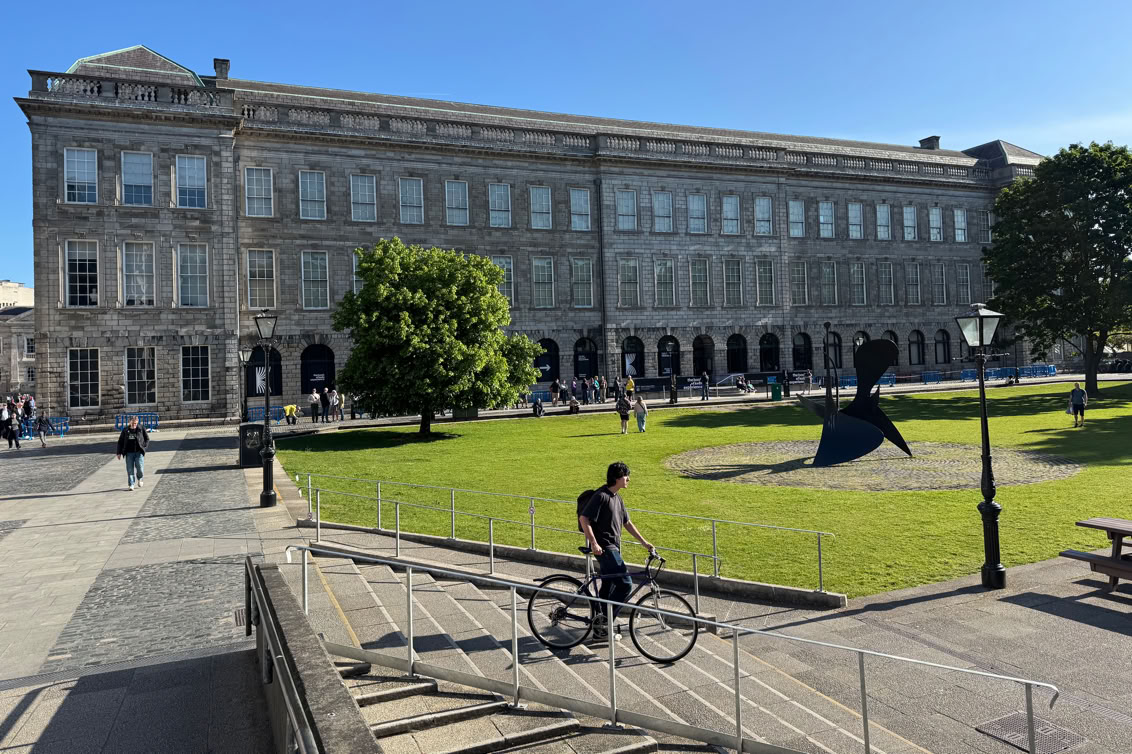
Above is the exterior of the library building with visitors lined up to enter. Below are two photos of the old library room.


You can see in the
photo above that beyond
the first few rows,
there are no books
on the shelves. The link
above for the library shows it
with all the books in place.
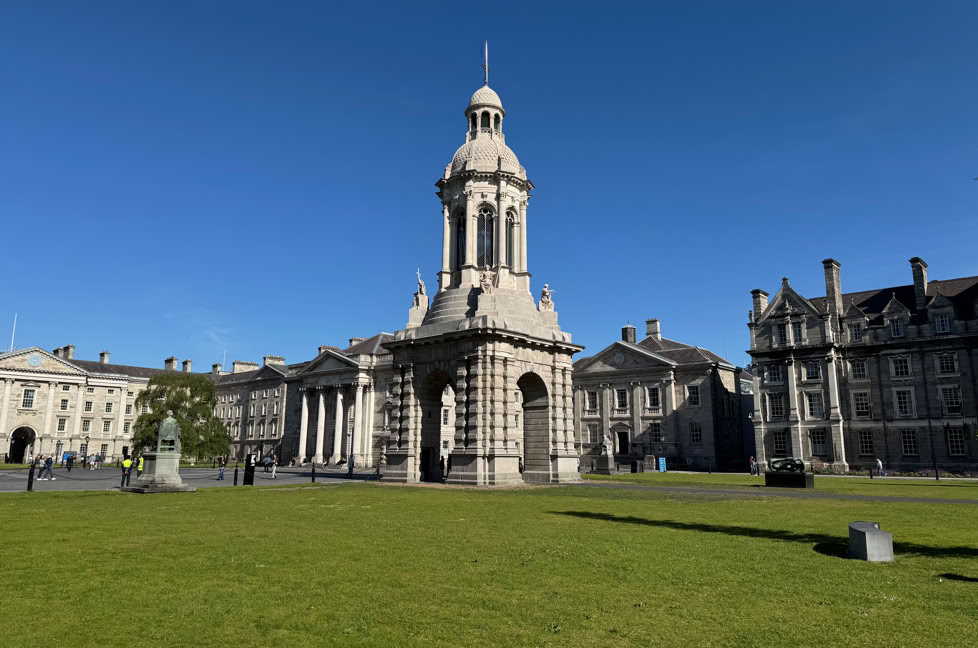
After the tour was completed, we walked through a lovely quad with Georgian architecture, which is the central part of Trinity College. Here are two photos of the campus.


Above are two photos from the museum displays,
the one on the right being the Cong Cross.
From there, we walked past government buildings to Merrion Square, a lovely park which hosts food trucks on Thursdays. We decided after a walk through, to proceed to our next stop and have lunch on the way. After about 15 minutes walking north, we crossed the River Liffey on a pedestrian bridge and could also see the downstream Samuel Becket Bridge, which was designed by Calatrava.

Before our one o’clock tour, we visited the haunting Famine Memorial, along the river.


This plaque reflects the fact that many Irish fleeing the famine emigrated to Canada.
We next took a tour that provided us a great deal of information about the 19th Century Irish potato famine (1845-1852). This one-hour tour took us through the famine sailing ship, Jeanie Johnson. The ship is, in fact, a replica of a tall ship that made 16 voyages from Ireland to North America (both the US and Canada), taking people fleeing the terrible famine to the New World. The guide told us the Jeanie Johnson had better conditions and outcomes for emigrants than other ships, also at the time called Coffin Ships. The voyage typically took about 6 weeks, and about 200-250 made each journey. The Jeannie Johnson was apparently the only famine ship never to lose passengers on any of its voyages. Typical ships’ fatalities were about 25% of passengers. Here is a photo of the ship.

After this sobering lesson about the famine, we went across the street to the EPIC Museum, which commemorates Irish emigrants who have spread to all of the world’s corners. In fact, there are almost five time more Irish descendants living throughout the world (34 million) than the current combined populations of Northern Ireland and the Republic of Ireland (about 7 million). The museum had a lot of interesting information about famous Irish figures throughout the world, including four US presidents (Kennedy, Regan, Obama and Biden). We enjoyed the museum and its many interactive exhibits.

This is the pedestrian bridge we used to cross the river, with EPIC in the background.
From there, we took a taxi back across the river to our hotel. We then walked less than ten minutes to St Patrick’s Park and Cathedral. There were many people lounging in the park and enjoying the wonderful sunshine. St Patrick’s was quite similar to Christ Church, which we visited yesterday, although slightly larger and grander due to the wealth of the Guinness family that contributed to its restoration.
The site of the church is near the place St Patrick was thought to have baptized Irish people in the 5th century. (As an aside, we never heard anything about St Patrick and snakes.) The current church is ten years older than Christ Church—dating from the early 12th century—and replaced the one the saint built (like many old churches, made of wood).


The church’s tower is quite tall!
This plaque was in the garden.


The impressive interior of St. Patrick’s Cathedral, above.
To the left, a close-up of the choir.
Below is a side view with a statue of Sir Benjamin Guinness who funded restoration of the cathedral.


Above is a photo of people enjoying the park adjacent to the Cathedral.
This evening, we dined at a restaurant in the bustling Temple Bar area, shown right.
May 16, 2025
We started this morning a bit later than usual (since our first “appointment” was not until 9:45), and took a taxi for about 15 minutes to Old Kilmainham Gaol. There we took an informative tour that included lots of details about the history of Ireland and the many prisoners held in this jail. It played a pivotal role in the ultimate liberation of Ireland by changing public opinion, due to the many atrocities that occurred here. In addition to the old jail and neighboring courthouse, the modern museum housed many interesting artifacts including hand written letters about the history of the jail and its prisoners.

One of the later areas of the Old Gaol.
From there, we took another taxi to the General Post Office, which was instrumental in the Easter 1916 uprising. But since the sun was out and it was not cold, we decided to skip the museum and instead stroll around in the pedestrianized shopping area north of the river, including Henry Street. After having lunch in the area, we walked through a mostly residential area to the north and visited the 14 Henrietta Street Museum.
The neighborhood is very attractive, with Georgian Era buildings. The 75-minute tour provided a fascinating glimpse of Dublin history focusing on the changing occupants and uses of the large residential building. In its early days, it was home to a single wealthy family. After 1801, wealthy people fled Dublin, and the building was cut up into individual apartments. By the early twentieth century, it was a tenement housing over 17 families in horrible living conditions. It remained an occupied tenement until 1979! Hearing about the massive poverty that persisted in Dublin until the last part of the twentieth century was amazing, considering how prosperous and vibrant the city is today. Celtic Tiger indeed.

Henrietta Street. The actual building at No. 14 was in the deep shade, so this shows the opposite side of the street.
We next took a taxi to the area of Dublin known as the Liberties. The distilling of Irish whiskey declined through the twentieth century, and the last whisky distillery in Dublin closed in 1976. In the last ten years, several small, craft distilleries have opened, and we visited one of these, Teeling Brothers. We had a tour of the operations of the facility, including the beautiful copper distillers, before tasting three of their whiskies, the small batch, single grain and single malt. The taste beat out Scotch whisky hands down!


To the left is a copper distiller. Above are the three whiskeys we tasted.
From there, we walked about 15 minutes back to the hotel, and people were still sunning themselves in the park by St Patrick’s Cathedral. See photo at top of page.
On our way to dinner, we saw this crowd enjoying Friday evening.

Here is a map of the places we visited in Dublin.
Tomorrow, we will pick up a rental car and head out into the countryside.

From there, we walked about ten minutes to the branch of National Museum of Ireland which houses its Archeology collection. It has a vast collection from prehistoric times through the Neolithic period, the Viking age, and medieval Ireland. One of the most famous pieces is the decorated “Cross of Cong” (1122).
Between visiting the museum’s upper and lower levels, we took a break to have a coffee across the street!