To County Meath
Birr, Clonmacnoise, Newgrange and Travel Homeward


May 27, 2025
We left Galway in a heavy rainstorm and drove about 90 minutes through the flattest part of Ireland we have been in. It was mostly animal farms, though later in the day, we saw a “Wind Farm” with many large windmills generating electricity.

In a few places, we saw sheep and cows together in the same field, a new sight for us. The drive took us to the small town of Birr, where we visited the Birr Castle Demesne. The castle is a misnomer, as the principal structure isn’t really a castle, but a lovely stone house. Parts of the building date from the 16th century, but most of the interior furnishings are from the 19th century. The family who owns it (since 1620, the Parsons, who later got the title of Earl) has accomplished many fascinating things and they still live there to this day.
The tour of the interior rooms on the ground floor featured some amazing pieces of furniture and art. No photos were allowed, given that it is the family’s home. After visiting the castle and having lunch in its cafe, we walked to the famous giant telescope on the grounds. This was constructed in the 1840s and was the world’s largest telescope for over 70 years.


Front view of the “castle” and crest on the castle gate.


Two views of the telescope.
The information sign, below.


Castle view from the telescope path.
From there, we drove about 40 minutes to one of the most important monastic sites in Ireland, Clonmacnoise. Saint Ciarán (another saint new to us) founded a monastery on the banks of the Shannon River in 544 A.D. Although he died seven months later at age 33, the monastery flourished and became a great seat of learning, with a college attracting students from all over Europe. The ruins include a cathedral, two round towers, three high crosses, nine churches and 700 early Christian grave stones.
The original high crosses have been replaced at their outdoor locations with replicas, and the originals have been moved inside a modern museum building where they are protected from the elements and are displayed with other carved tablets. We watched a 20 minute video that explained the founding and fall of the site. It has been a ruin since the 1500s, but the site is still important to Irish Christians. Pope John Paul II visited it in the 20th century and 30,000 people showed up.


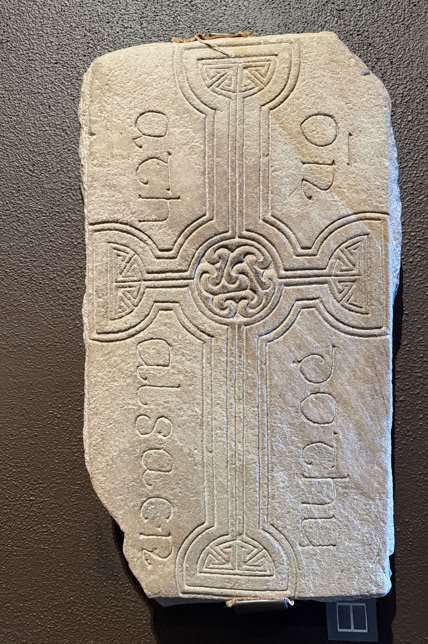

To the right are two high crosses and tablets from inside the museum. The photo above shows a replica high cross installed outdoors at the site.


There are two round towers here.

From there, we drove about 40 minutes to the medium sized town of Athlone. We had planned to visit the important castle here on the banks of the Shannon River (Ireland’s longest), but checking in to our hotel took a long time. So all we managed to do was walk down to the Shannon and look the castle over from outside, but not venture inside, due to time constraints. Here is a photo from the bridge.

Tomorrow is our last day in Ireland before heading home on Thursday. It started out rainy today, but we only had a bit of drizzle since mid-day, with long dry periods.
May 28, 2025
We left Athlone and drove about 75 minutes to the town of Trim. We thought its castle opened at 9:30, but it opened at 10, so we had coffee beforehand. We then walked across the street to Trim Castle, the best preserved Norman fortress in Ireland. Unfortunately, the timing of the tour of the castle’s keep did not work for us (timing of our tour at Brú na Bóinne), so we just walked around the exterior of the castle grounds.


Several views of Trim Castle.


Since we had additional time, we decided to see two more sites in County Meath before heading to Newgrange. First, we went to the Hill of Słane. There have been religious buildings at this site since St Patrick’s time (5th Century), but the current buildings are much more recent. This was an important site for religious learning from the 5th Century to the 15th Century. The site is attractively sited on top of a hill and has a few Celtic crosses, a bell tower and abbey ruins. Photos below.


We believe the tower is from the
15th Century.

View from the Hill of Slane.
From there, we drove to Old Mellifont Abbey, which holds ruins from a Cistercian Abbey founded in the 12th Century. The most impressive building was the lavabo (a place the monks washed their hands before dining). The ruins were very attractive and we were glad to have made this visit. Photos below.


Left photo shows the lavabo.
We then drove through the Boyne River Valley to the Brú na Bóinne Visitors Center (Brú na Bóinne means bend in the Boyne), which is the jumping off point for tours to the Neolithic sites in the area. We had about an hour before our tour started, so we ate lunch in the cafe, and walked through their fascinating exhibits describing the history and excavations of three large passage tombs, Dowth, Knowth and Newgrange.


View of Newgrange from the visitor center, left, and the River Boyne on the way to the bus, right.
The tour starts with a bus ride to the Knowth site. There we had about an hour guided tour of the exteriors where we learned the fascinating history of the site that has been used on and off for more than 5,000 years. This location has 17 mounds, the largest of which is a double passage tomb, 300 meters in circumference and 12 meters in height. It was not really possible to photograph the whole mound. Tours are not permitted into this passage tomb. The stones around the exterior, called kerbstones, were decorated and are some of the best Megalithic and Neolithic art in Europe.


Here are two examples of the art on the kerbstones.


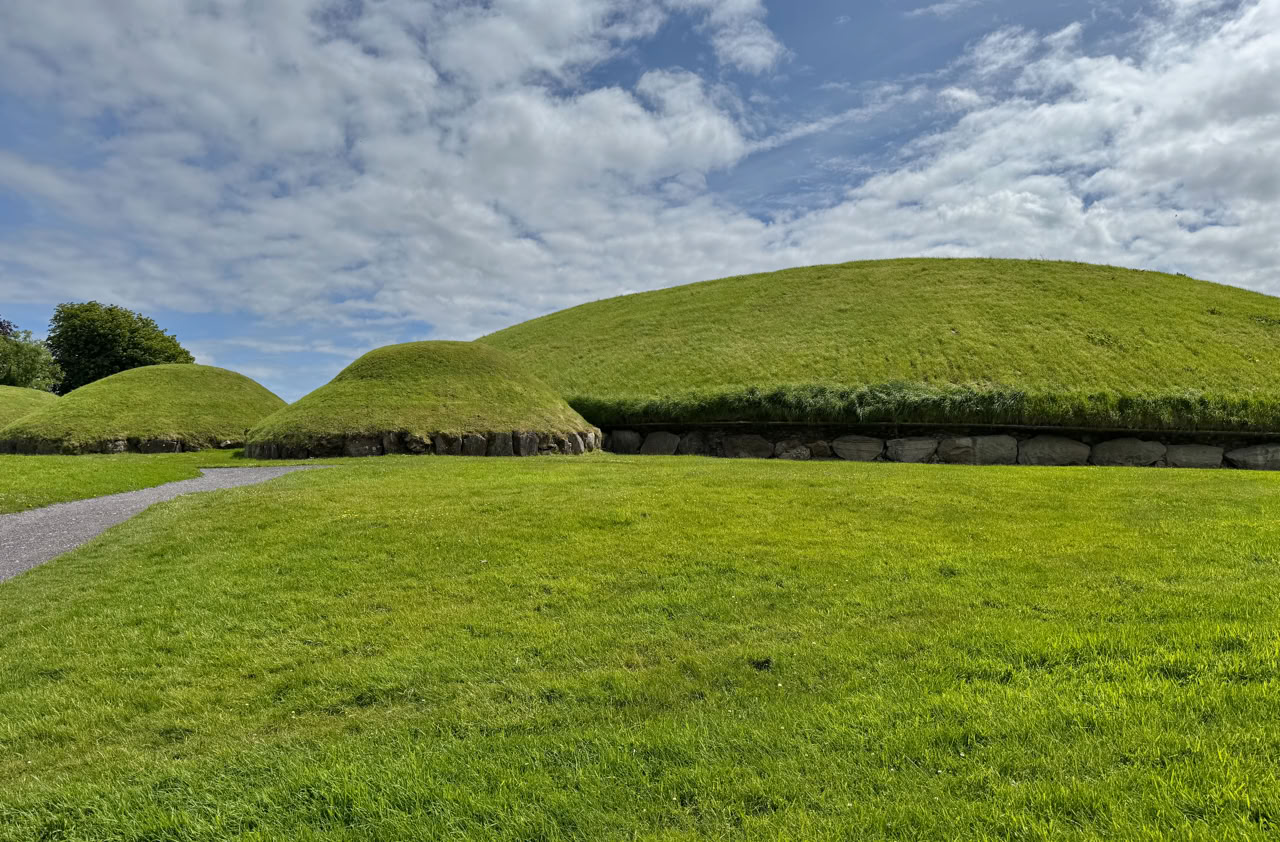
It was not possible to get a photo of the entire large mound. The next photo is a close up of its edge.

We climbed to the top of the large mound, where later civilizations, not knowing about passage tombs below, built homes and churches atop it. We could view Newgrange from this vantage point. This was a really fantastic tour. We knew about Newgrange, but the importance of Knowth was something we knew little about, and historically and architecturally, this part of the tour was the most interesting.


You can see Newgrange from
the top of the large mound at Knowth.
We then took another bus about five minutes to Newgrange, which is a single passage tomb (Knowth had two passages). When excavating this site, the archeologists figured out how to restore the exterior granite to a bit of the walls, so part of the exterior of the building looks like it did originally, thousands of years ago.
The tour here included entry into the tomb, where we walked along a very narrow, low passage to the chamber in the center. The chamber was large enough to hold 15 people, and the ceiling was 60 feet high and has not leaked in 5,000 years. It was spooky when they turned off the lights, and then did a demonstration of the effect of the sunlight during the solstice. Very cool.

This shows the entry door we walked through to get to the chamber.

After visiting the chamber, we walked the circumference of the structure, and then a bus took us back to the visitor center and our car. The tours to these sites were well organized! We were glad to end our trip to Ireland with such a highlight. From there we drove about 45 minutes to the seaside town of Malahide, where we would spend our final night in Ireland.
Today turned out to be a fine day without wind and rain, and we saw some amazing sites to cap off a great 15 days in the Emerald Isle. In fact, we really only had two days of completely bad weather, and 8 or 9 glorious days out of 15.
Here is the map of our journey from Galway to Malahide.
May 29, 2025
We drove less than a half hour to turn in our rental car near the Dublin airport, and then took a bus to the terminal. We had driven 2,206 km, approximately 1,200 miles in our brightly colored Suzuki Vitara, without incident (other than one low tire warning).
We flew 5,098 miles home from DUB to SFO arriving a bit early, but still in time for terrible rush hour traffic back to Oakland.
We enjoyed Ireland a great deal, more than we had hoped. The history was very interesting, the sights offered a great deal of variety, we mostly understood the language (!) and the landscape was quite beautiful. A wonderful trip.